


Georgetown, Del. (4 p.m. Thu., May 21, 2026): As Sussex County and America plan to celebrate the 250th anniversary of independence, and, of course, a bevy of backyard barbeques and beach bashes, there’s one other very important ‘to do’ that should be on everyone’s summer checklist: preparing for hurricane season.
As the six-month-long Atlantic hurricane season officially gets underway June 1, the Sussex County Department of Public Safety/Division of Emergency Management reminds the public to always be ready by taking various preparedness steps now – including creating a disaster kit – to limit damage and avoid loss of life.
“There’s a tendency each year to focus heavily on forecasts, and while it’s great this captures public attention, we want the public to focus on readiness in general, regardless of the predictions,” said Timothy Cooper, Sussex County emergency manager. “Don’t focus so much on the number of predicted storms, or the forecasted intensity. The effects could be just as damaging and deadly if a tropical storm became stationary. All it takes is one storm, so the message is to be prepared at all times for any scenario. Make a plan, create a kit, stay informed, and get engaged.”
Like other coastal communities from the Caribbean to Canada, Sussex County is vulnerable to the effects of tropical weather, from flooding to high winds.
Sussex County saw no direct effects from tropical weather during the 2025 season, with storms tracking away from the region. The year was slightly below average in the Atlantic basin, with 13 named storms during the season, including five hurricanes, four of which were major and caused billions of dollars in damage.
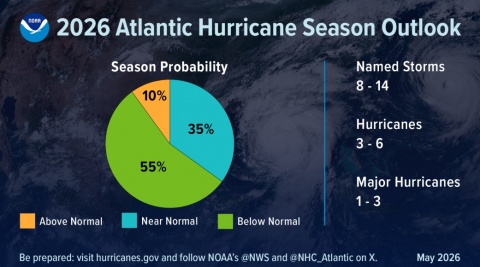
For the 2026 Atlantic hurricane season, the National Oceanic and Atmospheric Administration is predicting another below normal season, with eight to 14 named systems possible. Of those, three to six could become hurricanes, with one to three possibly reaching Category 3 strength or higher, according to NOAA’s May 21 forecast. Forecasters expect a strong El Niño pattern to shape the 2026 season.
El Niño years tend to suppress Atlantic hurricane formation and result in average to below average seasons; during that phase, waters in the equatorial eastern Pacific are warmer, creating lift in the atmosphere that tends to lead to wind shear and inhibit storm formation. Conversely, during La Niña years – the cooling of equatorial Pacific waters – hurricane formation in the Atlantic can rise significantly.
An average Atlantic hurricane season sees 14 named storms, including seven hurricanes, with three classified as major, based on NOAA’s 30-year average.
No matter the number of storms forecast, all it takes is one to come to fruition and wreak havoc. That’s why preparation is key ahead of each season, officials said.
One step residents can take ahead of hurricane season is to create a Safety Profile for their household with the free Smart911™ service to provide potentially critical, life-saving information up front to first responders. Profiles can contain as much or as little information as users want, including details about their properties, special medical conditions and family contacts.
To help make the storm season safer for everyone, there are several steps you can take to make your home and family ready for hurricane season:
- If you live in a flood-prone or other vulnerable area, be prepared to evacuate. Plan your evacuation route now. Emergency managers will notify the public, via the media, of what areas should evacuate and when. In the event you evacuate, take a storm kit. Take valuable and/or important papers. Secure your house by locking the windows and doors. Turn off all utilities (gas, water, electric, etc.). Notify a family member or someone close to you outside the evacuation area of your destination.
- Secure all outdoor items. Property owners also will need to secure their boats. Area residents should clear rainspouts and gutters and trim any trees that may pose a problem during high winds.
- Have a family disaster kit. This kit should include the following items:
- A three-day supply of water. This should include at least one gallon of water per person per day;
- Non-perishable foods and a manual can opener;
- A change of clothes and shoes for each person;
- Prescription medicines;
- A blanket or sleeping bag and pillow for each person;
- Personal hygiene items;
- A flashlight and extra batteries for each person;
- Special needs items, such as formula and diapers for infants, as well as items needed for elderly or disabled family members;
- A portable radio with extra batteries;
- Money. During power outages, ATMs will not work;
- Fuel. Gas pumps are also affected by power outages, so it is a good idea to have fuel in advance.
- In the event of an approaching storm, travel during daylight hours. Do not wait until the last minute to make plans or to purchase gasoline and supplies. When a storm watch is issued, you should monitor the storm on the radio and television. An evacuation could take 24 to 36 hours prior to a storm’s onset.
- If ordered to evacuate and seek shelter elsewhere, follow the instructions of local emergency managers on where to go and when. Authorities will announce shelter locations in advance of their opening, which could include multiple sites to accommodate larger populations.
- If not ordered to evacuate and you decide to take shelter in your home, have your disaster kit ready. Keep your important papers with you or store them in the highest, safest place in your home, and in a waterproof container. Even if you seek shelter in place, you need to secure your home by locking the doors and windows. Turn off all utilities (gas, water, electric, etc.). Monitor the storm by portable radio to keep up with the latest information. Stay indoors. Try to stay in an inside room away from doors and windows.
- Use your phone sparingly. Make only essential calls and keep the calls brief. Report emergencies to 911. When reporting emergencies, identify yourself and your location, making sure to speak clearly and calmly. If you have a mobile telephone, make sure it is charged and ready to use at all times. Remember, however, that cell service may be interrupted during and after the storm.
Hurricanes and tropical storms can have devastating effects. In the event a hurricane affects our area, expect polluted water, limited communications, no electricity, overflowing or backed-up sewers, undermined foundations, beach erosion and heavy damage to homes and roadways.
Do not re-enter the area until recommended to do so by local authorities. As you re-enter the area, be aware of possible hazards such as downed trees and power lines. Be aware of debris and water on roadways. Upon re-entry, have identification and important legal papers ready to show officials proof of residency. Continue to use your emergency water supply or boil water until notified that the drinking water is safe. Take precautions to prevent fires.
For more information on preparing for hurricane season, including Know Your Zone evacuation maps and preparedness brochures, as well as volunteering as a Community Emergency Response Team (CERT) member or amateur radio operator, visit Sussex County’s hurricane homepage at www.sussexcountyde.gov/hurricane-information, PrepareDE’s website at www.preparede.org, or the NOAA Weather Ready Nation homepage at www.weather.gov/wrn/.
###